
Why Pop Secular Morality Doesn't Work


Before I became a Christian I used to love playing poker. I got pretty good too.
One thing you realize when you play poker is that sometimes it’s really hard to play against terrible players because they have no idea what they’re doing. They might call your bluff all the way to the river because they think jack high is a great hand, it can be extremely frustrating. I haven’t gambled in many years, but I still feel that same feeling of frustration at times when I discuss metaethics with atheists. Just like a terrible poker player, they have no idea what sort of hand they’re really sitting on, they have a 7 high and they think it’s a royal flush. I can demonstrate all the mistakes they’re making, and it goes completely over their head, no matter how simply I explain it. I guess I shouldn’t be too annoyed, I was the same way when I was an atheist. In my egoism, I couldn’t imagine that atheism would be unable to ground or make sense of things like evil or obligations. It took me years to come to terms with that reality.
When I finally did, I left atheism.
But many atheists are still out in limbo like I was… without cards or chips… and without a clue. One of those atheists is Lilith.
A few hours ago she posted this:
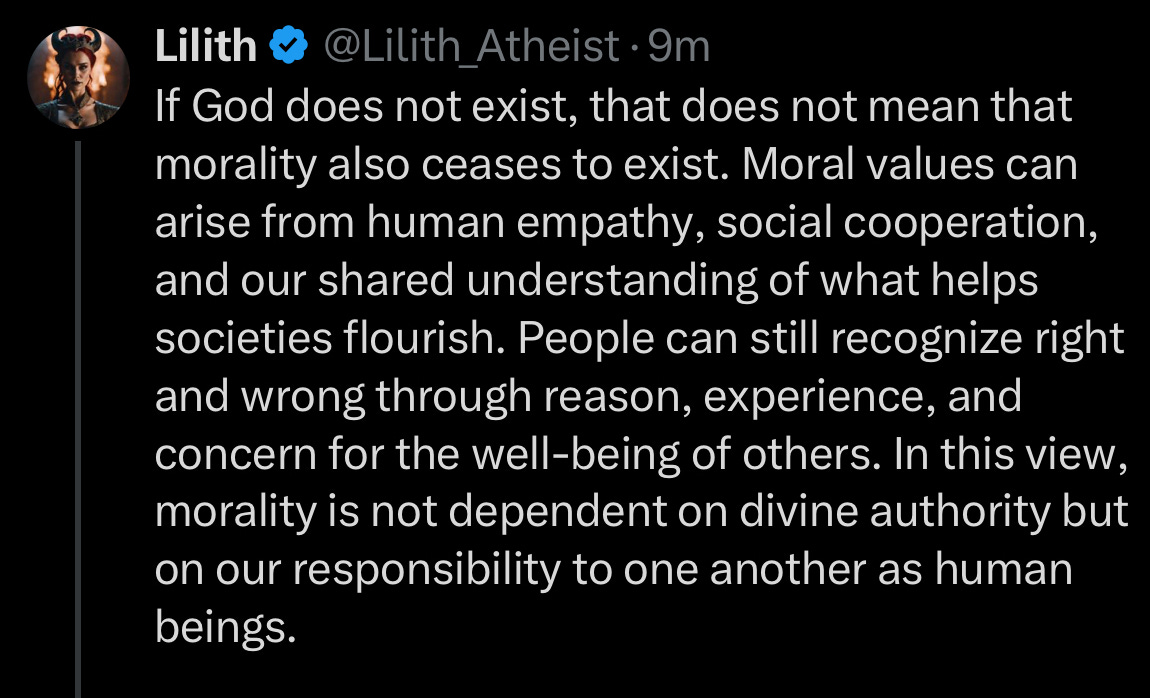
For those of you that are listening, it says the following:
If God does not exist, that does not mean that morality also ceases to exist. Moral values can arise from human empathy, social cooperation, and our shared understanding of what helps societies flourish. People can still recognize right and wrong through reason, experience, and concern for the well-being of others. In this view, morality is not dependent on divine authority but on our responsibility to one another as human beings.
Seeing her comment I decided to make a full response because this is very common atheist rhetoric whenever you talk about morality. It’s worth going through this even if most atheists can’t understand it because at least other believers can, and who knows… an atheist might too. After all, I finally did.
So I’m going to break her entire argument down, part by part, and explain what’s happening and why none of this works.
Now… let’s get started.
Lilith begins:
“If God does not exist, that does not mean that morality also ceases to exist. Moral values can arise from human empathy, social cooperation, and our shared understanding of what helps societies flourish.”
My response:
Firstly, when we ask if morality is real, we need something that can actually explain where things like values and obligations would come from. We are not asking why humans happened to evolve a belief in morality. Imagine if I tried to prove that God exists by saying, “belief in God arises from humans being superstitious as a survival strategy.” Would that prove that God exists because I appealed to human evolution to explain why we believe in God? Quite the opposite. Likewise, saying morality arises from an evolutionary trait like empathy doesn’t mean morality is real, it just means you can explain why humans might believe in morality. Who cares about that? This can’t get you real values or obligations.
Also, when atheists say “values come from empathy,” they mean people can reason from empathy. Atheists are saying they have an arbitrary emotion or ability to “feel” what others feel and then they base how they act on this ability. They think, “I don’t like to feel pain, so I’ll try to help other people avoid pain, because they’re probably like me and don’t like it.” Seems simple enough right? I agree that people can subjectively value empathy and reason from it to act nicely towards other people. The problem is this is totally irrelevant, why? Because people can reason from anything.
People can value any emotion or worldview they want. Just as Lilith might reason from her totally arbitrary ability to empathize, other people can reason from fear, hatred, selfishness, Islam, Nazism, etc.
All of these different worldviews and starting places will cause one to act in different ways towards other people.
Which one is “right?”
There is no right.
This is the problem.
Lilith isn’t grounding why humans have obligations, she’s just telling us one story about why humans behave socially with each other. This has nothing to do with where values or obligations come from.
Just because you don’t want to see other people in pain doesn’t mean you now have a real and binding obligation to not cause pain to other people, any more than it follows that a person should cause others to feel pain because it excites them. Both individuals can have a reason for causing or not causing pain, but having a reason to do something is not the same as having a real obligation to do it. When you have an obligation that means you are compelled to act even if you think it’s stupid or don’t understand it.
Just to be clear, I’m not denying that we perceive values, I agree we do. However, perception is not reality. What I’m arguing is that these values can only be a reality if God exists. Without God, we can’t ground real values. Subjective values on atheism become more like a mirage. They appear real to us, they feel real, but there’s nothing there in reality itself. If you and I both experience a mirage, my perception is not more real or true than your perception. It’s the same with subjective values.
Lilith also brings up shared cooperation. Humans do cooperate, that’s true. Does that mean we have an obligation to cooperate? No.
Imagine if I observe that humans throw garbage into the ocean, would that mean humans have a real obligation to throw garbage into the ocean? Obviously not. Lilith is making one of the most common mistakes in ethical discussions, it’s called the is-ought fallacy. Just because something is the case, doesn’t mean it ought to be the case. Just because it is the case that humans work together, that doesn’t mean we ought to work together, nor does it mean working together is good. She’s trying to pull prescription (how we should behave) out of descriptions (what is the case).
In the show “Invincible” the antagonists are a planet of highly evolved super beings called Viltrumites. The Viltumites survival strategy was to fight and killed anyone that was weak. No mercy. This is how they evolved godlike powers, by being ruthless. According to Lilith’s argument, wouldn’t we have to say the Viltumites actions are good too? Why wouldn't they be? Just as humans evolved as social creatures, the Viltumites evolved as ruthless creatures that showed no mercy. You could even make the case they’re more moral, because they are more successful as a species. It’s all arbitrary nonsense.
But I want to be clear here… if atheism is true, and humans evolved to work together, that would explain why humans would subjectively value working together, it would also explain why humans value things like their eyes or their hands. Anything that helps us survive, we’d value. But just because evolution has arbitrarily wired us to value things based on our survival strategies, that doesn’t mean what we value is actually valuable. Instead, this would still just be subjective value.
Lilith also said morality is derived from human flourishing.
Here’s the problem. Whether or not you think a society is flourishing is going to depend on what you initially value. If a society is extremely free, a libertarian will say “this is flourishing,” but a communist would likely say “this is unacceptable.”
Who’s right?
Again, there is no right.
It just depends on what evolution has arbitrarily programmed you to value, that’s it. Frankly, the concept of human flourishing is nonsense on atheism, because for something to flourish that means it’s being successful. How can humans be successful if we have no purpose? A clock can be more or less successful because a clock is made FOR a purpose, to tell the time. A clock that tells time accurately is successful, a clock that does not tell the time is unsuccessful. But if atheism is true then humans have no actual purpose, we’re an accidental byproduct of nature. We are not made for anything. The idea of human flourishing makes zero sense within an atheist framework.
Lilith continues:
“People can still recognize right and wrong through reason, experience, and concern for the well-being of others.”
My response:
No one is arguing atheists can’t recognize right and wrong. The question is whether or not what we recognize is real, or imaginary. Imagine a determinist saying, “I believe in free will because we all recognize people experience that they freely make decisions.” If someone said that you’d rightly wonder if they had any clue what they were talking about. If they really believed in determinism then our perception of free will should be considered an illusion, it would be something we don’t actually have. In the exact same way, just because we have moral experiences and intuitions that values and obligations exist, that doesn’t mean they actually exist.
Lilith then says that we recognize right and wrong through reason, experience, and concern for the well-being of others, but this just continues her earlier mistake. She’s beginning with an arbitrary starting point, namely that it’s wrong to harm others because human beings are a social species or because she has empathy. From there, she reasons about which actions will bring about what she already values. Then she uses her experience to further determine which actions created more or less harm. Based on her reason and experience, she refines her actions further to avoid what she does not value and promote what she does value.
But the key point is that she already starts with concern for the well-being of others.
As I already said, this is all completely arbitrary, because anybody can start anywhere. Someone else can start from hatred for others and then reason that other people should be harmed. They can then use their experience, based on that starting value, to hurt other people even better.
If there’s no actual truth about the matter, then their actions would be no less right or wrong than Lilith’s. Once again, Lilith is simply starting from some value that she either makes up or that she is arbitrarily programmed by evolution to care about, and then she uses her reason and experience to behave in the world according to it.
None of this has anything to do with whether or not human beings really have obligations.
To make my point, consider this: Even if human beings have zero real obligations to each other, they could still make up arbitrary values, reason from them, and gain experience in the world.
So this fundamentally misses what is even being talked about in this conversation.
Lilith ends with:
“In this view, morality is not dependent on divine authority but on our responsibility to one another as human beings.”
My response:
Why would I have a responsibility to other people if atheism is true. There’s nothing with real authority saying I do, so why do I? Is it because Lilith has a reason based on her personal values for why I should? Maybe I have different values. My values are that Lilith should keep her personal arbitrary values… to herself.
Conclusion:
This article is not meant to show why all secular metaethical theories fail, just the extremely common one that Lilith and many other atheists espouse. I am well aware that this is low hanging fruit and there is much higher level fruit that I should also deal with, and I intend to in other articles. This article is just meant to show why the common rhetoric from atheists doesn’t even come close to working. It doesn’t work because it tries to get prescriptions from descriptions, and it makes all our moral experience nothing more than meaningless arbitrary subjective opinion with no real dimension. Lilith hasn’t grounded obligations or values, only our perceptions of them… that’s all they’d be on her frame work… perceptions. Fictions. Imagination. The same way she views God.
If you believe, like I do, that humans really do have obligations, that evil is real and that it’s really true that things like child sex trafficking are wrong, you should completely reject what Lilith argues… just like I finally did.
Because sometimes the best move is to simply fold and go get a different set of chips.
Great post 🏆🏆🏆
I’ve had this discussion with atheists many times through the years. And the problem is that most times they assume people can choose morality without belief… Because they’re living in a Christian nation and absorbed the Christian values by osmosis. If they grow up in a non-Christian nation that already practices barbarity… They will find those practices normal. And then they will begin to rationalize them, because their morality is fleeting and subjective, and typically based on what is “normal”, not what is actually right.
She pitches a softball, but it is still important to swing and hit it as hard and far as you can. Her argument works on many because it appeals to emotion and it appeals to self-justification (pride).
IMO, the quickest and sharpest point here is to apply the exact same logic behind "evolution makes morality real and true" to conclude that "evolution makes religion real and true." Atheists love to claim that the cross-cultural ubiquitousness of belief in higher powers is the (very ironic) product of evolution. If being a product of evolution makes something real and true, as they argue it does for morality, then why does it not also make religion real and true?