
Refuting Euthyphro's Dilemma... Again
Response to Ben Watkins

“God is not good because he causes goodness, but rather goodness flows from him because he is good.” — Thomas Aquinas
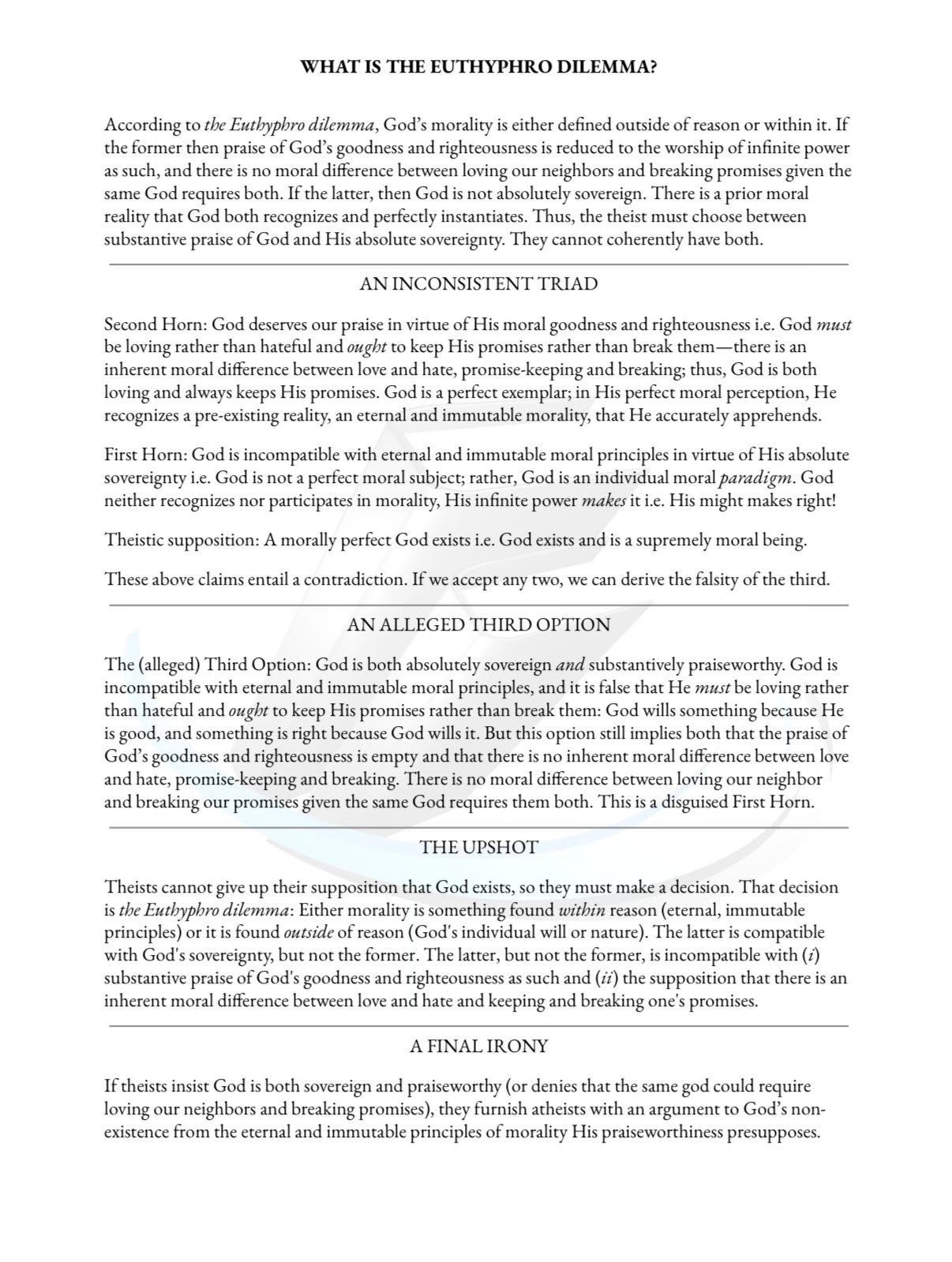
A few days ago my friend Ben Watkins posted a new update on the Euthyphro dilemma. After thinking about it I decided to explain why I think it doesn’t work. You can find Ben’s argument here:
Before I get into Ben’s brief, I want to give a few general remarks about this dilemma that I think will be helpful to the reader.
The Euthyphro Dilemma doesn’t mean that moral realism can’t be true if God exists. What it’s trying to do is say that if God exists and morality is objective, then our moral obligations either come from something outside of God and are independent of God and don’t require Him, or they come from God but they’re arbitrary. I find this sort of argument very strange because if God exists, He would be the foundation of reality. Nothing can exist independent of God. That means IF God exists and the Euthyphro is sound and valid, the wrongness of things like rape, murder, and torture would seem disconnected from any stable moral foundation and would somehow still have to be arbitrary. I think even Ben would say this couldn’t be the case. These things would still be wrong in a meaningful way even if God is the foundation of morality. It seems bizarre to me to say, “well it’s meaningfully wrong to torture children if morality isn’t grounded in God, but if it IS grounded in God then the wrongness of child torture is totally arbitrary.”
From this the real question becomes: How is it the case that things are still meaningfully wrong if they’re grounded in God? When you think about it in this way the answer becomes obvious, and frankly it’s been obvious for hundreds of years. God is good. If God is good, then His commands will be good. Just as a maximally intelligent being cannot say stupid things, a maximally good being cannot command evil things. Ben knows this is the move and he’s addressed it in his brief, so let’s go through it. He writes:
“The (alleged) Third Option: God is both absolutely sovereign and substantively praiseworthy. God is incompatible with eternal and immutable moral principles, and it is false that He must be loving rather than hateful and ought to keep His promises rather than break them: God wills something because He is good, and something is right because God wills it. But this option still implies both that the praise of God’s goodness and righteousness is empty and that there is no inherent moral difference between love and hate, promise-keeping and breaking. There is no moral difference between loving our neighbor and breaking our promises given the same God requires them both. This is a disguised First Horn.”
Ben’s primary argument is to say that if whatever God commands is good will be good because God commanded it, then there’s no meaningful difference between right and wrong. If God commands promise breaking rather than promise keeping, or murder rather than securing the safety of our fellow man, then those things God commands will be good. If moral goodness is entirely determined by God’s commands then the only distinction between good and evil is simply that good is what God commands and evil is what God condemns. Ben thinks that if morality is based on will rather than reason, morality becomes empty. I believe I’ve understood and steel-manned Ben’s argument, now let’s address it.
The main problem with this argument is that Ben seems to want to disconnect God’s will from God’s nature, as if the will of God is disconnected from God’s nature and just free floating like a leaf on the wind. But this doesn’t make sense. One’s will comes from one’s nature. A good and loving parent will make rules and give instructions based on their good nature. If you ask Ben why he tells his children to not play in the street, Ben would say it’s because he loves them. Ben’s will to keep his children from harm is based on his good character. If Ben was a bad father who wanted to harm his children, we’d expect him to will them to play in the street while cars went by. The quality of the character is what produces the will which creates the rules for his children to obey. A good parent will make good rules, and a bad parent will make bad rules. This is why we all want our politicians and rulers to be good, because we know that if they’re good we’ll get good and fair laws. If they’re corrupt we’ll get laws that are unfair and that hurt most of us for the benefit of a few. The better someone’s character, the better their will.
Now that we’ve established this, what kind of character does God have? To be God is to be perfect, to be all good, all wise, all knowing, all rational, etc. God is a perfect being. If you had a perfect father, or a perfect ruler, they couldn’t command things that were wrong or bad. Neither can God. This means that Ben is getting the order wrong. Goodness is not created by God’s commands, rather God’s commands flow necessarily from His perfectly good nature. Ben thinks that God can command anything and whatever God commands will just “be good” simply because God commands it. In reality God, a perfect being simply is good and so His commands will be good.
If Ben’s children are talking with their friends and the friend asks, “why do you do what your father says? Don’t you know that he only tells you what to do based on his arbitrary will, and he could just as easily tell you to play in the street rather than stay away from it?” I think Ben would hope that his children would respond by saying something like this: “These commands are not arbitrary, they come from my father who is good, who loves me, whatever my father tells me to do is for my benefit. The only way my father could tell me to play in the street is if it was somehow the correct and loving thing to command. Since he tells me not to go in the street, I know that this is what a good parent commands.” Now if that makes sense with Ben and his commands towards his children, why is it suddenly different with God? It isn’t. God wills what is good because God is good.
Perhaps a stronger point to consider is rationality. To be rational is to conform with some standard of reason that we’re all somehow intuitively aware of. When someone makes a bad inference and says something like “last time it rained the cowboys won, and it’s raining now so the cowboys will win again” we know that sort of reason doesn’t work. They’ve made a mistake and the inference doesn’t follow. They’ve reasoned badly. There are rules of inference that if violated lead to bad or false conclusions and we all know this. To argue assumes this. But what if rationality is grounded in God? These rules of inference that we all have awareness of, if they reflect the perfect thinking of God and that’s where they come from, are they suddenly arbitrary as well? I think even Ben would reject this. Rules of inference would still be valid and non-arbitrary if they’re grounded in a perfectly rational mind. Imagine tomorrow Ben realizes that God exists and grounds reality, would Ben say “well now that I believe in God, rationality is arbitrary because God grounds it.” No, I think Ben would reject that unconditionally. And I don’t know any theists that believe rationality is arbitrary because it’s grounded in God either. So if Ben agrees that rationality wouldn’t be arbitrary if it’s grounded in God’s perfectly rational nature… why can’t morality be non-arbitrary as well? The point is that God can obviously ground some things without them becoming arbitrary. If that’s true then why can’t God ground morality without it becoming arbitrary? Perhaps Ben will want to say that morality is normative and rationality isn’t? Not so fast. Rationality IS normative. When someone makes a bad inference we ought not accept their conclusions. That’s normative. When we realize our argument doesn’t work we ought to abandon it or fix it—that’s normative. When we make an argument we ought to comport it with the rules of inference, that’s normative. So if both rationality and morality are normative, then it seems that this move is not open to Ben.
Unless Ben can tell us why reason is substantively different than morality, we have no reason to think that grounding morality with God would be any more arbitrary than grounding rationality. If Ben wants to continue to press the Euthyphro dilemma, the burden is now on him to make this case.
Conclusion
While the Euthyphro dilemma does pose some interesting questions, upon close examination we find that it’s riddled with misunderstandings and untenable conclusions. The main misunderstanding is the idea that God’s commands are separated and distinct from His perfect nature, rather than simply being the outflowing effect of a perfect moral nature. Not only this but if the Euthyphro dilemma goes through, we’d have to say that if God does exist as the foundation of reality, then suddenly morality would become arbitrary and there wouldn’t really be any distinction between harming and helping. Lastly, given that rationality is also normative and reason giving, Ben needs to give us a very good reason why we should think rationality isn’t arbitrary if God grounds it, but somehow morality still is. Until Ben or some other atheist can do this, I think the Euthyphro dilemma is far less decisive than many atheists assume.

Like many atheist objections, it applies equally as well against atheism…or I should say it applies against atheism and is solved by Christianity. Here’s why, I could say “is something wrong because you atheist say it’s wrong? (Arbitrary) Or do you say it’s wrong because it’s wrong? (So what’s the basis of the standard?)”
I've actually heard several atheists say that the "Euthyphro Dilemma" isn't really a big problem for the Christian at all. Even the atheists realize its flawed😄